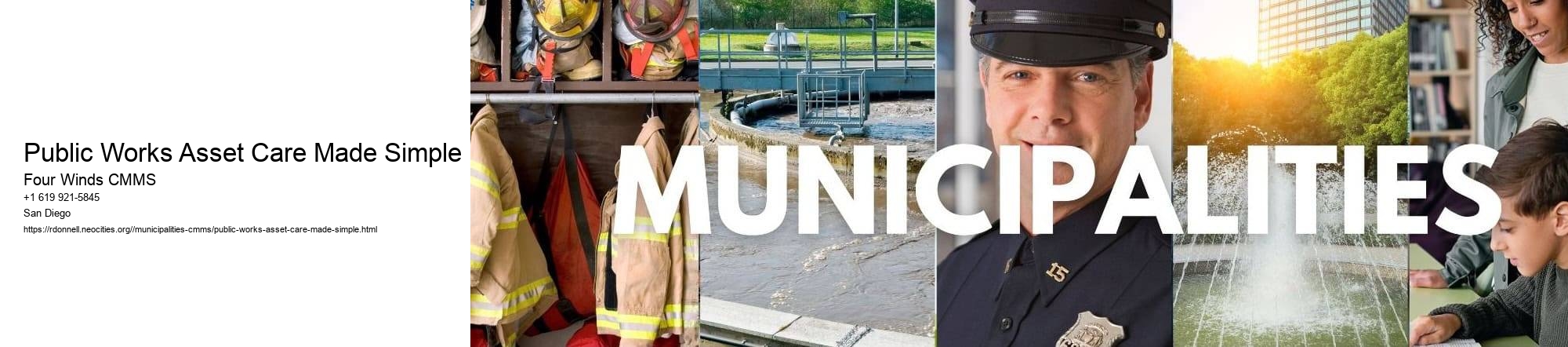
Public Works Asset Care Made Simple

Public Works Asset Care Made Simple

Staying compliant becomes less stressful with maintenance records always ready.

City governments today face growing pressure to manage public assets, maintenance schedules, and compliance responsibilities more efficiently than ever before. Using a Municipalities-CMMS allows municipalities to centralize maintenance activities and improve operational control. Manual maintenance tracking creates unnecessary risk that can be reduced with a structured CMMS platform.

Public works departments oversee critical infrastructure that must remain safe and operational.

Staying compliant becomes less stressful with maintenance records always ready.

  1. Field technicians benefit from mobile access to work orders.
A Municipalities-CMMS helps organize these assets into a single system where maintenance history, schedules, and performance data are easy to access. This level of organization helps teams shift from reactive maintenance to preventive maintenance, reducing costly emergencies.

Clear work order processes help public works teams stay aligned and accountable. Staying compliant becomes less stressful with maintenance records always ready. Work order visibility improves communication and reduces delays. CMMS Software Built for Real Municipal Challenges . Technicians can complete tasks and document work directly from the field.

Municipalities must meet regulatory requirements related to safety, inspections, and maintenance documentation. Accurate documentation reduces compliance risk and administrative burden. Having reliable records readily available supports accountability and transparency across municipal departments.

Cost control is another major benefit of adopting a Municipalities-CMMS. Better planning leads to more efficient use of labor and materials. Clear cost visibility supports smarter financial decisions.
Municipal operations often involve multiple departments that must coordinate maintenance activities. Unified systems support smoother operations across the organization. This approach improves accountability while allowing each department to maintain appropriate control over its responsibilities.

Unlike generic maintenance software, Four Winds CMMS focuses on real municipal workflows. Municipal staff can start using the system quickly. Municipalities can adapt the system to changing needs.

Reliable infrastructure directly impacts the quality of life for residents. A Municipalities-CMMS helps ensure that roads, facilities, utilities, and public spaces receive the care they need. Proactive planning replaces constant firefighting.

Modern cities require smarter maintenance tools. CMMS Software For City Maintenance Crews A Municipalities-CMMS provides a practical foundation for long-term operational success. With the right CMMS in place, city governments can manage assets responsibly, reduce risk, and plan for the future with confidence.

Public jobs are a wide category of infrastructure tasks, funded and acquired by a federal government body for recreational, employment, and health and wellness makes use of in the greater area. They consist of public buildings (courts, schools, and hospitals), transport facilities (roadways, railways, bridges, pipelines, canals, ports, and airports), public rooms (public squares, parks, and coastlines), civil services (water supply and treatment, sewer treatment, electric grid, and dams), environmental management (alcohol consumption water security, dirt disintegration reduction, wild animals environment preservation, preservation and restoration of woodlands and marshes) and other, typically long-term, physical assets and centers. Though usually compatible with public facilities and public capital, public works does not always lug a financial part, therefore being a more comprehensive term. Building and construction might be carried out either by straight used work or by a private operator. Public functions has actually been motivated given that classical times. The Roman emperor Nero urged the construction of numerous facilities projects during widespread deflation.

.

A job order is usually a job or a job for a client, that can be arranged or assigned to somebody. Such an order may be from a consumer request or created inside within the company. Job orders may additionally be created as comply with ups to inspections or audits. A work order may be for services or products. A work order must include the following: Requestor Date of request Request information Location Preferred conclusion day Priority level Job approved by Summary of completed job Work finished by Day of conclusion In a manufacturing atmosphere, a job order is transformed from a sales order to reveal that job is about to start on the manufacture, structure or engineering of the items requested by the consumer. In a service atmosphere, a work order can be equal to a solution order where the WO documents the location, day and time the service is executed and the nature of work that is done. The sort of personnel (e. g. work position) might additionally be provided on the WO. A price (e. g. $/ hr, $/ week) and also the overall variety of hours functioned and overall worth is also shown on the job order. A job order might be a maintenance or fixing demand from students, professors or personnel in an university. Orders obtained from outside an organization are typically dispatched (reviewed and set up) prior to being implemented. Job orders might be for precautionary maintenance Professionals might make use of a solitary job work order and billing form which contains the client details, explains the job performed, lists charges for material and labor, and can be offered to the consumer as an invoice. A task order is an internal record thoroughly used by projects-based, manufacturing, structure and manufacture companies. A job order might be for products and/or solutions. In a production environment, a job order is used to signal the beginning of a production procedure and will most likely be linked to an expense of product. Thus, the job order will probably state: the amount of the item to be manufactured, constructed or fabricated the quantity of resources to be made use of, its rate and quantity the kinds of labour called for, price (per hour or per unit) and amount the maker utilisation for each and every device throughout the directing process, its price and quantity In a service setting, a job order can not be the comparable to a work or solution order where the task order records the place, date and time the solution is accomplished and the nature of solution that was carried out, the work order does not. The sort of personnel (e. g. task setting) may additionally be listed at work order. A rate (e. g. $/ hr, $/ week) and additionally the overall variety of hours functioned and total worth is likewise shown.

.

A digital maintenance administration system (CMMS) is any type of software package that keeps a computer data source of info regarding an organization's maintenance operations. This information is planned to assist upkeep workers do their tasks more effectively (for instance, determining which devices call for maintenance and which storage rooms consist of the extra components they require) and to help administration make informed decisions (as an example, computing the expense of machine malfunction repair versus preventive upkeep for each and every machine, potentially bring about much better appropriation of sources). CMMS data may also be made use of to confirm regulative conformity. To appropriately manage the maintenance of a facility, info is required to analyze what is happening. By hand, this calls for a remarkable amount of effort and time. A CMMS additionally allows for document maintaining, to track completed and assigned tasks in a timely and affordable way.

.

Asset monitoring is an organized technique to the administration and realization of all value for which a group or entity is accountable. It might use both to substantial possessions (physical things such as complicated process or manufacturing plants, facilities, structures or tools) and to abstract properties (such as intellectual property, goodwill or financial possessions). Property management is an organized procedure of developing, operating, maintaining, updating, and dealing with assets in the most affordable way (consisting of all costs, dangers, and performance characteristics). Theory of property administration largely manages the periodic matter of enhancing, preserving or in other scenarios guaranteeing the economic and capital worth of a property gradually. The term is frequently made use of in design, the business world, and public facilities fields to guarantee a coordinated method to the optimization of costs, risks, service/performance, and sustainability. The term has actually traditionally been made use of in the monetary industry to describe people and business who take care of investments in behalf of others. Those consist of, for example, investment managers who handle the possessions of a pension plan fund. The ISO 55000 collection of requirements, established by ISO TC 251, are the international standards for Possession Management. ISO 55000 supplies an introduction and needs spec for an administration system for asset management. The ISO 55000 criterion defines a property as an "product, thing or entity that has prospective or real value to an organization". ISO 55001 specifies needs for an asset administration system within the context of the organization, and ISO 55002 gives standards for the application of a property monitoring system, in accordance with the requirements of ISO 55001.

.

Framework is the collection of centers and systems that serve a nation, city, or various other area, and encompasses the solutions and centers needed for its economic situation, houses and companies to operate. Framework is composed of public and private physical frameworks such as roadways, railways, bridges, airports, public transit systems, tunnels, supply of water, sewage systems, electric grids, and telecommunications (consisting of Net connectivity and broadband accessibility). Generally, infrastructure has been defined as "the physical parts of related systems providing products and services essential to allow, sustain, or enhance social living conditions" and preserve the surrounding atmosphere. Particularly in light of the large societal makeovers required to reduce and adapt to climate adjustment, contemporary framework conversations regularly focus on sustainable growth and environment-friendly framework. Recognizing this significance, the international neighborhood has actually produced policy concentrated on lasting infrastructure through the Sustainable Development Goals, specifically Lasting Development Objective 8 "Market, Innovation and Framework". One method to explain different types of infrastructure is to categorize them as 2 distinct kinds: difficult infrastructure and soft facilities. Difficult facilities is the physical networks required for the performance of a modern industrial culture or market. This includes roadways, bridges, and trains. Soft facilities is all the institutions that maintain the economic, wellness, social, ecological, and cultural requirements of a nation. This consists of educational programs, official stats, parks and entertainment centers, law enforcement agencies, and emergency services.

.

About San Diego

Frequently Asked Questions

Municipalities-CMMS is designed specifically for city governments and public works departments that manage public assets such as roads, utilities, fleets, parks, and facilities. Unlike generic CMMS tools, it supports municipal workflows, compliance requirements, and multi-department coordination, making it better suited for public sector operations.

Municipalities-CMMS can be used by public works departments, water and wastewater teams, fleet management, parks and recreation, facilities management, utilities, and city infrastructure teams. Multiple departments can work within the same system while maintaining clear responsibility and visibility.

By enabling preventive maintenance and better planning, Municipalities-CMMS helps municipalities avoid costly emergency repairs and unplanned downtime. Tracking labor, parts, and asset performance also allows city leaders to make informed budget decisions and extend asset life.

Yes, Municipalities-CMMS keeps detailed records of inspections, maintenance activities, and service history. These records help municipalities meet compliance requirements related to safety and regulatory standards and make audit preparation easier and less stressful.

Municipalities-CMMS is designed with simplicity in mind. Field technicians can access work orders, update tasks, and record maintenance activity using mobile devices, reducing paperwork and improving accuracy without requiring extensive training.

Implementation is typically straightforward and faster than traditional enterprise systems. Most municipalities can begin using Municipalities-CMMS quickly without complex IT infrastructure, allowing teams to see benefits in a short time.

Yes, Municipalities-CMMS is ideal for small to mid-sized municipalities that need powerful maintenance management without unnecessary complexity. The system is scalable, meaning it can grow alongside municipal operations as asset portfolios and teams expand.